Talaria Tread Tracker
Your shoes know more than their mileage.
A multi-factor wear model that tracks how your shoes actually degrade — not just how far you've gone. Built on HealthKit, backed by research, private by design.
🏔️
Terrain-Aware Tracking
Automatically detects trail, road, and treadmill via GPS elevation analysis. Trail runs carry a higher wear multiplier because uneven surfaces stress foam differently than flat pavement.
🧬
Biomechanics from Your Watch
If your Apple Watch records cadence, ground contact time, or vertical oscillation, those metrics feed into per-workout wear estimates using pace-aware targets.
🔄
Shoe Rotation Rewards
One 264-runner study (Malisoux et al., 2015) found fewer injuries among runners who rotated shoes. We credit your shoes for rest days between runs.
🏃
Session Grouping
Warm-up walk, interval run, cool-down walk? We detect the full chain automatically and assign it to one shoe — capturing your actual workout, not three separate fragments.
Talaria Tread Tracker
My Shoes
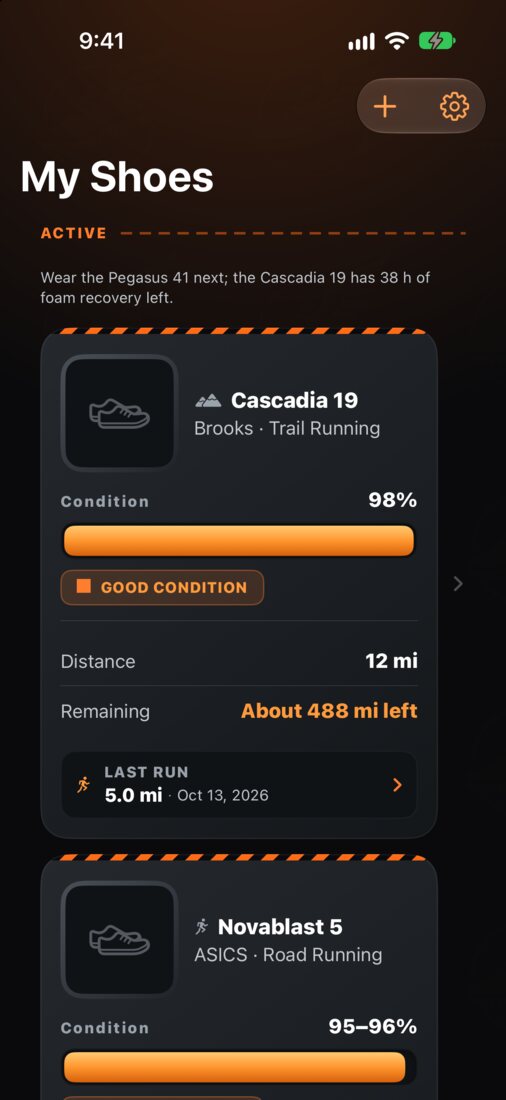
Every pair gets a card: how worn it is, the miles on it and the miles left in it. The top line suggests which pair to wear next, based on how long each shoe's foam needs to recover.
Shoe detail
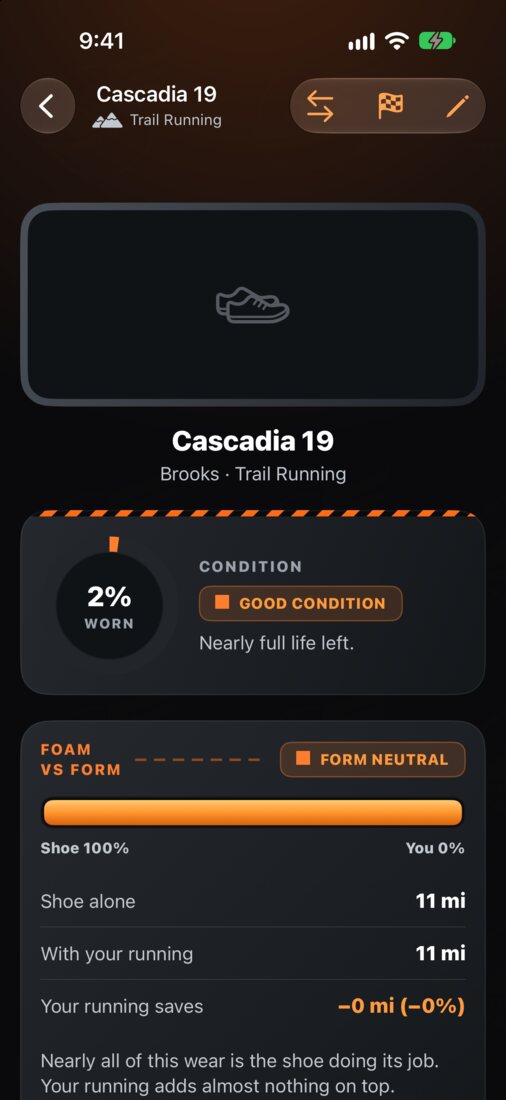
Wear shows as a range, because it's an estimate. A card splits that range into what the foam does on its own and what your running adds.
Workouts
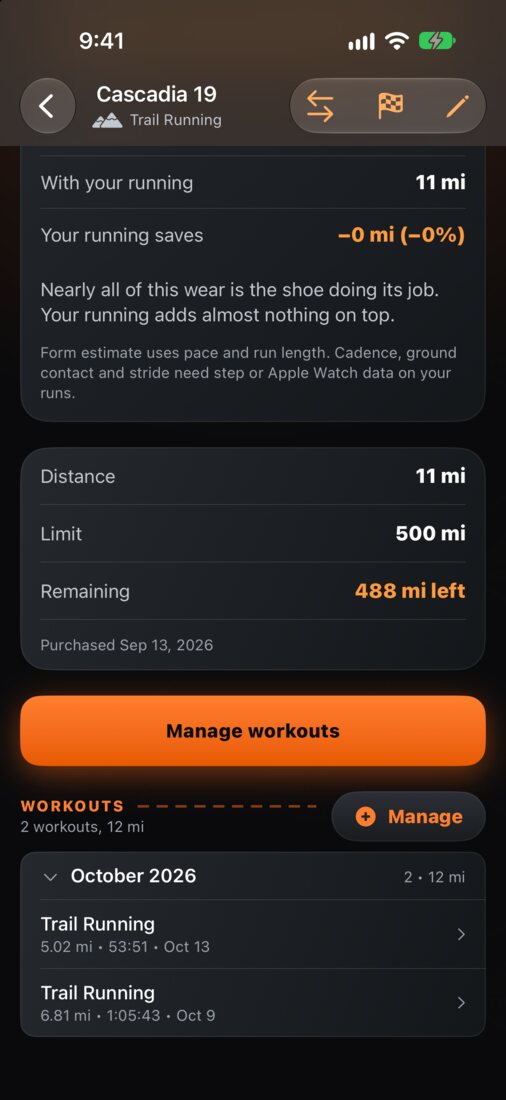
Further down: the distance run, the mileage limit, the miles left, and the HealthKit workouts assigned to this pair.
⛰️
Terrain
Trail 1.3x, road 1.0x, treadmill 0.8x — auto-detected via GPS.
📈
Elevation
Climbing adds equivalent mileage. GPS-smoothed to filter noise.
⚡
Pace
Faster pace = more impact force. Continuous interpolation, no step functions.
🌡️
Temperature
EVA foam softens in heat and stiffens in cold. Both accelerate degradation.
⏱️
Duration Fatigue
Longer runs change your gait. Runs over 60 minutes carry a fatigue multiplier.
🧬
Biomechanics
Cadence, ground contact time, vertical oscillation — all pace-normalized.
🔄
Rotation & Rest
Rotating pairs varies how each step loads the shoe. Up to 35% wear reduction credited.
📅
Foam Aging
Midsole foam degrades over time even unworn. +4% per 6 months on the shelf.
See the full wear methodology — every factor, its multiplier, and where the data comes from.
Why not just use Strava?
Strava counts miles. We count impact. They're complementary — use both. Strava tracks your fitness, Talaria Tread Tracker tracks your shoe health.
See the Full Comparison
-
✓
HealthKit integration — Automatic import of running, walking, and hiking workouts
-
✓
iCloud sync — Shoes and assignments sync across all your devices. No account needed.
-
✓
Wear shown as ranges — "45–55% worn" with (est.) labels. No false precision.
-
✓
Pace degradation detection — Flags >8% slowdowns as a potential wear signal (with caveats).
-
✓
In-app methodology — Every factor links to peer-reviewed research with evidence quality ratings.
-
✓
Built for accessibility — Dynamic Type up to the largest sizes, VoiceOver labels throughout.
-
✓
Privacy-first — All analysis on-device. No analytics, no tracking. Strava is optional; sync uses your own iCloud.
-
✓
Shoe photos — Capture at purchase and retirement. See the journey your shoes took.
Available Now on the App Store
Science-backed shoe wear tracking for $2.99. No subscriptions, no analytics, no tracking.